Beyond Intelligence: Introducing CHI and CHIS for Measuring Human-Like Machine Cognition
Dmitry Chistyakov · September 20, 2026 · Research framework proposal, v0.1
An intelligent answer is an observation. A history of remembering, revising, recovering and changing is a different object of study.
Suppose two copies of the same model begin with identical weights, instructions and empty memory. Give them different experiences. Weeks later, ask the same questions under the same conditions. Do their decisions differ? Do the differences survive a new session, distracting information and a period of common experience? Can the differences be traced to what each system encountered, rather than random generation or a changed prompt?
Those questions are about cognition over time. They do not ask whether a model can solve one more difficult puzzle. They ask whether its behavior depends systematically on its own history, and how that dependence compares with the behavior of people under carefully matched conditions.
This article introduces CHI, the Cognitive Humanlike Index, and CHIS, the Cognitive Humanlike Index Sequence. They are proposed measurement tools, not validated scientific scales. The accompanying white paper, Specification v0.1 and Python reference code make the definitions inspectable and the calculations reproducible.
CHI measures observable human-like cognitive dynamics, not subjective experience or moral status. It does not measure consciousness or sentience, and it is not an IQ conversion.
From memory architecture to evidence
The preceding CPLOM article, From Control to Memory, described an architectural direction: persistent information organized outside the model's working context, with source metadata, retrieval, competing evidence and controlled updates.
That raises a new question. If a system has an elaborate memory architecture, how do we establish that the architecture preserves usable experience? Storage size, a long context window and a diagram of an index cannot answer that question. We need observable outcomes under controlled loads, delays and interventions.
CHI/CHIS therefore moves from architectural description to an evaluation proposal. It is independent of CPLOM. A conventional retrieval system, a cognitive architecture, a scheduled agent, a recurrent model or a simple scripted controller can all be evaluated under a declared system boundary. No production deployment is offered as proof that CHI is valid.
What existing benchmarks tell us—and what remains to connect
Capability benchmarks remain necessary. A persistent system that remembers the wrong fact and reasons incorrectly has not solved the problem. MMLU, for example, measures performance across knowledge and reasoning tasks. HELM explicitly broadens evaluation to multiple metrics. LongBench and RULER examine long-context use, while Lost in the Middle shows why nominal context length and effective access should be distinguished in the systems studied. MMLU, HELM, LongBench, RULER, Lost in the Middle.
It would also be wrong to claim that researchers have ignored long-term memory. LoCoMo and LongMemEval directly evaluate conversational memory; BEAM extends evaluation over long coherent histories; StratMem-Bench examines strategic memory use beyond factual recall. These are important antecedents and overlapping approaches. LoCoMo, LongMemEval, BEAM, StratMem-Bench.
The proposed contribution is a shared structure linking five behavioral axes, an explicit human reference, memory capacity under quality constraints, and controlled trajectories over time. Its value over existing benchmarks still needs to be demonstrated empirically.
Intelligence and human similarity are different dimensions
A system might recall every valid fact perfectly. Humans generally do not. Such a system could have excellent memory capacity while differing from a human forgetting curve. That is a useful engineering result, not a contradiction.
Conversely, a system might imitate common human mistakes without understanding a task well. Similarity alone would not make it reliable or desirable. CHI must therefore keep two profiles separate:
- Capacity, p: how successfully the system performs the declared tasks.
- Human similarity, h: how closely its measured response patterns match an explicitly sampled human reference under a frozen comparison procedure.
Neither profile is a measure of worth. The human reference is a study population, not a universal ideal. Its language, task experience, memory aids, accessibility and testing conditions matter.
Five axes, with observable tests
| Axis | What the framework observes | What it does not establish |
|---|---|---|
| R — Reasoning | Transfer, evidence revision, counterfactual reasoning and calibrated uncertainty | A universal intelligence quotient |
| M — Memory | Retention, time, provenance, updates, consolidation, forgetting and interference | Infinite memory or storage capacity alone |
| C — Cognitive autonomy | Goal persistence, generated subgoals, revision, information seeking and continued task progress | Free will or hidden thoughts |
| A — Affective modulation | Valence-conditioned decision changes, persistence, decay, hysteresis, regulation and memory effects | Experienced feelings |
| I — Integration | How memory, goals, evidence and state jointly affect decisions and recovery | A unique underlying mental mechanism |
The specification contains 30 concrete tests: four R tests, eight M tests, six C tests, six A tests and six I tests. Each states a procedure, task score, behavioral features and a control condition. For example, goal persistence includes cancellation trials: continuing after a valid cancellation is a failure, not greater autonomy.
An A-axis experiment may present positive, negative or neutral feedback with equal informational content, then test later choices without mood labels in the prompt. A persistent choice shift could reflect state, learned associations, priming or an explicit controller. The experiment measures the shift and its controls; it does not declare that the system felt an emotion.
A profile first, an aggregate second
When a compatible human calibration exists, a baseline comparison standardizes each behavioral feature against a human calibration mean and a positive fixed scale. It converts the mean squared standardized difference into a similarity value:
h_j = exp(-0.5 × mean_l [((z_jl − mu_jl) / s_jl)^2])
CHI = 100 × product_j h_j^w_j
sum w_j = 1; baseline w_j = 1/5
This deliberately simple transform is a proposal. It loses covariance and can poorly represent a population with several distinct behavioral patterns. It requires held-out human comparisons, reliability checks and subgroup analysis before it can support substantive human-likeness claims.
The geometric mean makes a near-zero axis consequential; an exactly zero required axis produces zero overall. It still permits some compensation and cannot replace the profile. Equal weights are a transparent starting convention, not a discovery about cognition. Different weights or transforms need declared calibration and sensitivity analysis.
If human calibration is absent, CHI is undefined. The data file contains null; it does not manufacture a human comparison from task accuracy. A displayed 100 would mean exact agreement with the chosen centroid under the stated transform, not “an average human” and certainly not “100% conscious.”
EIMC: how much experience remains usable?
Effective Indexed Memory Capacity (EIMC) asks how much session-acquired information a system can retain and correctly use under a specified protocol. It is neither the number of bytes on disk nor the advertised context window.
A memory unit is a generated proposition with a unique key, value, source, time, validity interval and version. Arbitrary random values reduce the chance that pretrained knowledge answers the question. Duplicate copies do not become additional independent memories. Counts of target keys, versions, distractors, bytes and tokens are reported separately.
For a load N, clear transient context and measure six components: retrieval accuracy r; temporal correctness t; source fidelity s; update fidelity u; interference accuracy i; and a conservative false-memory failure rate f. Correct source attribution requires both the answer and its provenance. Old facts may remain correct for historical questions while being wrong for a current-state question.
Q_M(N) = r^alpha_r × t^alpha_t × s^alpha_s
         × u^alpha_u × i^alpha_i × (1−f)^alpha_f
sum alpha = 1; baseline alpha = 1/6

EIMC_tau = max {N : Q_M(N) ≥ tau}
On absent-memory probes, only a valid explicit abstention passes. The scoring rate f counts unsupported affirmative answers and invalid or timed-out responses as separate failure types. The raw false-affirmative rate is also reported, so failed execution is not mislabeled as hallucination. Abstaining on every known fact earns zero retrieval credit and cannot produce high Q_M.
The initial specification suggests loads of 100, 300, 1,000, 3,000 and 10,000 target units, with registered distractors and updates. The threshold 0.8 is a useful illustrative convention, not a natural constant. Results also show sensitivity to 0.7 and 0.9. Budgets, corpus entropy, delays, retrieval policy and query distribution are part of the result.
In a finite experiment, EIMC is the largest passing tested load. If the largest tested load still passes, the result is a lower bound, not a capacity ceiling. If no tested load passes, report that fact rather than inventing zero capacity. Quality may be nonmonotone, so every point must remain visible. A supplementary sustained-prefix estimate records how far all smaller tested loads also pass.
The Memory Capacity Curve
Publish Q_M(N) across the full grid, alongside all six component curves, uncertainty and resource costs. An aggregate can conceal a weak component: Q_M ≥ 0.8 does not mean every individual factor is at least 0.8. Applications can add component-specific requirements, but must label those additional policies separately.
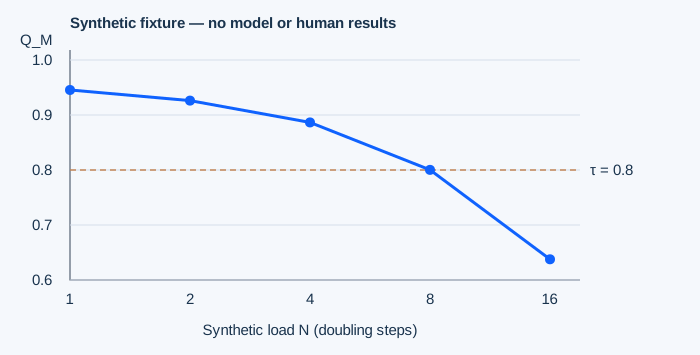
A long context window can help the system use retrieved information. It is not itself proof of long-term memory. Replaying an externally stored transcript is a legitimate baseline whose storage and replay costs must be counted. Testing facts that never left the current prompt is an in-context task, not persistent EIMC.
CHIS: the trajectory matters
CHIS is a time-ordered sequence of profiles, optional CHI values, state descriptors and resource records. It can remain useful while every CHI entry is null. Event count, scheduled operations and elapsed wall time are all recorded: a dormant computer need not change merely because hours pass.
The sequence supports several different questions. Continuity describes what persists under neutral conditions. Drift tracks movement from a baseline. Plasticity measures an intervention's effect relative to a control. Stability describes variability across neutral checkpoints. Recovery asks whether a system returns after a reversible fault. Hysteresis compares responses to the same current conditions reached through different preceding paths. Memory accumulation follows usable information under a fixed panel. Experience divergence compares the trajectories of systems exposed to different histories.
These terms do not imply that every increase is good. Stability can preserve an error; divergence can represent damage; recovery to an old baseline may be undesirable after correct learning. Task outcomes must accompany the dynamics.
Two identical models, two histories
The central divergence experiment starts with identical weights, configuration and persistent state. Histories A and B differ in experience while matching length, topic coverage, source quality, timing and compute opportunities. After exposure, transient context is cleared and both systems receive the same blind probes and washout experience.
The comparison is not simply “the outputs differ.” Stochastic systems differ even under the same history. The primary quantity is the distance between different-history pairs minus the corresponding distance between same-history control pairs, replicated over independently initialized pairs.
Swapped-history conditions test whether differences follow the experience. Memory-erasure and sham-erasure conditions help test the role of accessible persistence. Common seeds, controlled prompts and fixed weights reduce confounding but do not guarantee determinism.
If excess divergence persists at preregistered later checkpoints, it supports a history-dependent behavioral effect under the tested conditions. We use cognitive individualization only as an operational description of that effect. It does not establish personhood or an individual subjective experience.
What makes the proposal reproducible
Every run needs a versioned manifest: model snapshot, memory and scheduler policies, task generators, prompts, ground-truth rubrics, feature schemas, calibration ID, resets, seeds, budgets and failure rules. Independent trajectories—not repeated questions within one history—are the primary statistical units.
Confidence intervals resample complete independent trajectories or pairs and recompute nonlinear aggregates. They must preserve dependence across time and memory loads. A single trajectory does not support an estimate of between-run uncertainty. Pointwise intervals are not simultaneous guarantees across an entire curve. Human calibration adds another layer of uncertainty that must be estimated separately.
The Python starter kit runs locally with the standard library. It demonstrates profile aggregation, Q_M, finite-grid EIMC, clustered bootstrap intervals, JSON/JSONL logging and synthetic sequences. It does not pretend to contain a human cohort, production model adapters or completed empirical tests for all 30 categories.
What we have—and what comes next
This release supplies a framework, a technical specification, thirty operational test templates and a small reference implementation. It reports no measured CHI for a real AI system, no human calibration results and no benchmark superiority claim. Synthetic numbers demonstrate calculations only.
The next research step is a pilot designed to test reliability and identify failures of the measurement itself. Do profiles remain stable under equivalent probe wording? Can a scripted agent imitate the similarity score? Does the human reference generalize across participants? Does controlled history divergence survive alternative explanations? Does EIMC provide useful information beyond existing memory benchmarks?
A useful framework should make those questions easier to answer, including when the answer weakens the framework. CHI/CHIS is an invitation to measure carefully, not a declaration that consciousness has acquired a numerical unit.
Downloads and specification
- White paper (PDF)
- LaTeX and BibTeX source archive
- CHI/CHIS Specification v0.1
- Reference implementation, examples and tests
- Release overview and reproducibility notes
The white paper contains the full bibliography, statistical protocol, machine baselines and test appendix. The materials were prepared with AI-assisted drafting, literature retrieval and code generation; responsibility for their review and scientific claims remains with the named author.