Governing decisions.
Organizing memory.
CPLOM investigates the architecture around intelligent models: how outputs are evaluated, evidence is selected, and experience remains usable across time.
Originating as the Cross-Layer Predictive Logistics Optimization Model, the research now extends its verification and governance principles to long-term Context Storage.
Architecture
A model reasons over the context it receives. A surrounding control layer decides which evidence enters that context, how alternatives are challenged, and what may become an action or a persistent memory.
Memory Model
The context window is working memory. Context Storage is a separately indexed collection of source objects, with tags, provenance, versions, temporal scope and links across a hierarchy.
Retrieval & Routing
Fast relevance analysis narrows candidate branches before payload retrieval. Bounded parallel operations examine selected records while preserving explicit budgets and failure information.
Parallel Reasoning
Competing contexts support separate assessments. Candidate answers guide further retrieval, including searches for exceptions and counter-evidence. Agreement alone does not establish truth.
Memory Organization
The research agenda includes consolidation, contradiction handling, confidence calibration, aging and forgetting. These are lifecycle requirements, with open questions and an explicit evaluation protocol.
Reference Implementations
Four small Python examples demonstrate hierarchy, tag routing, bounded relevance scoring and hypothesis refinement. Standard library only; synthetic data; separate from production code.
Results: what survives a fresh start?
Measured notebook memory and short-history behavior from Grok 4.6, GPT-6 Astra, Claude Fable 5.1 and Kimi K3. Explore the graphs, inspect actual answers and download the data.
A limited empirical pilot. Human-calibrated CHI is not yet available.
Publications
- CHI/CHIS: A Human-Referenced Framework for Longitudinal Evaluation of Artificial Cognitive Systems
White paper · v0.1 · 21 pages. LaTeX + BibTeX · Specification · Research release.
- Beyond Intelligence: Introducing CHI and CHIS
Longitudinal cognition, human-reference calibration and effective indexed memory capacity. White paper, specification and code.
- From Control to Memory
Long-term Context Storage, retrieval and memory organization.
- Why AI Needs Architecture to Become Infrastructure
Decision systems as the layer between prediction and execution.
- From Correction to Adjudication
Competing interpretations, structured challenge and procedural governance.
- From Reactive Optimization to Predictive Governance
State representation and control across coupled operational layers.
- From Metrics to Market Dynamics: Early Deployment Lessons
The operational origins of cross-layer predictive control.
- Cross-Layer Predictive Logistics Optimization Model
Original technical white paper, version 1.0 (PDF).
White Papers
Two separate research papers: the original CPLOM architecture and the CHI/CHIS evaluation framework.
New white paper · September 20, 2026
CHI/CHIS: A Human-Referenced Framework for Longitudinal Evaluation of Artificial Cognitive Systems
Dmitry Chistyakov · Version 0.1 · 21 pages
A framework for measuring reasoning, memory, cognitive autonomy, affective modulation and integration over time, with effective indexed memory capacity, human-reference calibration and 30 test templates.
Framework proposal. The paper defines the measurements; human calibration and independent empirical validation remain open. All paper materials and reference code →
Foundational white paper · December 13, 2025
Cross-Layer Predictive Logistics Optimization Model
Dmitry Chistyakov · Version 1.0
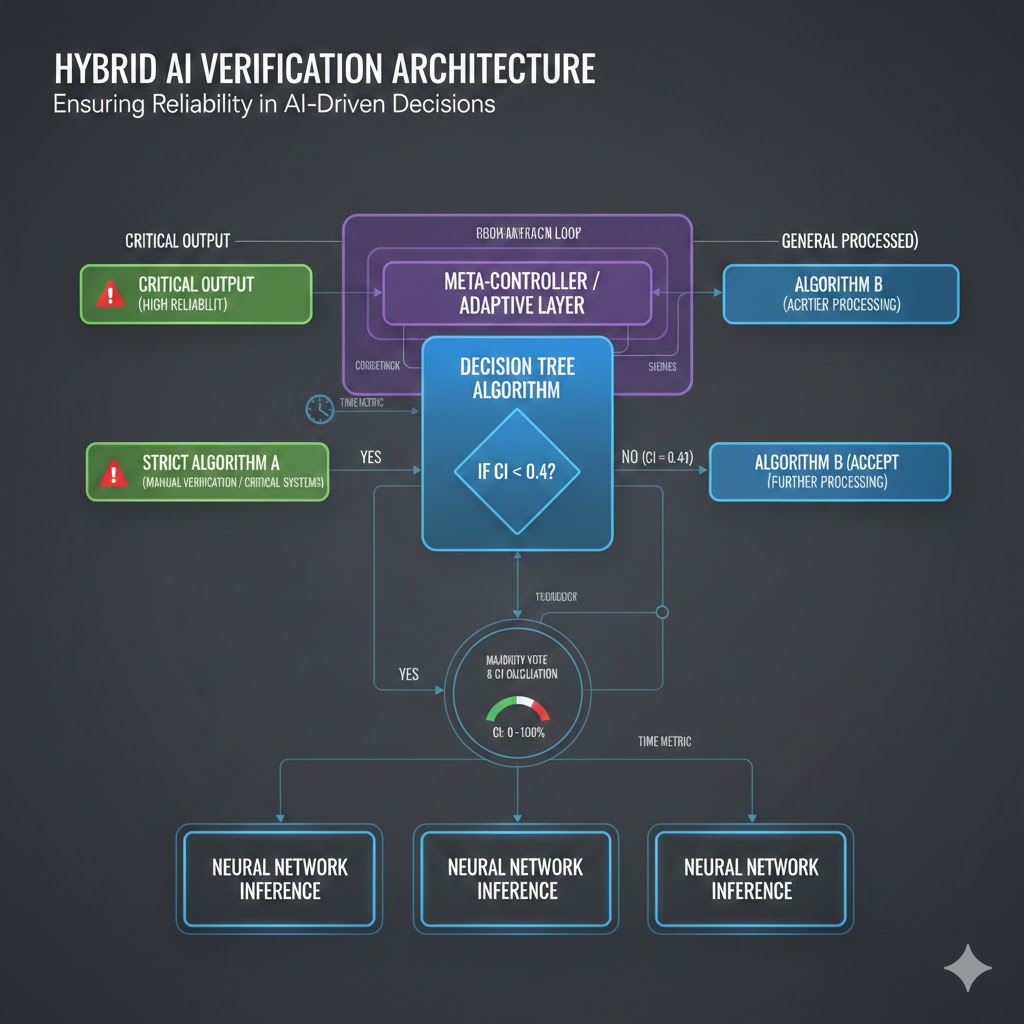
The original CPLOM work describes forecasting, operational state indices and hybrid neural–deterministic verification across coupled logistics layers.
Implementation Context
Earlier publications describe operational implementations in logistics. The newer memory work develops the same separation between model outputs and architectural governance.
The publication distinguishes author-reported implementation details from proposed mechanisms and independent evaluation. Educational examples are provided for inspection and do not reproduce the production system.
Author
Dmitry Chistyakov · Chief Technology Officer · Enterprise IT Architect
Research interests: distributed systems, predictive control, decision governance and long-term memory architecture.